
Most wedding mornings get planned from one side. The dress has a hanger chosen weeks ahead, the bouquet arrives at a set time, the room is picked for its window. Down the corridor, or across town, the groom is getting dressed in whatever room was left over.
Then the gallery arrives and the couple notice the gap.
It's an easy fix, and a cheap one. What follows is how to plan the groom's half hour so it photographs as well as the rest of the day, whether you're getting married in Zurich, by a lake, or somewhere up in the Swiss Alps.
Why photograph the groom getting ready at all?
Because it's the quietest part of the day that still has something happening.
Nobody is waiting on a speech. Nothing is running late yet. A shirt gets buttoned, a cuff gets fastened, someone pins a flower to a lapel, and all of it happens with hands, close to a window, at a pace slow enough to watch properly. For the way I work, standing back and noticing rather than directing, it's close to ideal.
It also gives the album a second beginning. A gallery that opens only on the dress tells half the morning. One that cuts between both rooms tells the whole of it.
Where should the groom get ready?
Choose the room for its light, not its size.
One big window to the side is worth more than three small ones or a wall of downlights. Side light from a window gives white cotton shape and depth. Overhead hotel lighting flattens a white shirt into a single grey shape and puts shadows under everyone's eyes.
Next, look at the walls. Plain is best: pale wood, white plaster, anything that doesn't compete. The frames in this post have warm timber behind almost every one of them, and it does half the work. A busy wallpaper or a cluttered shelf ends up in the background of every close-up whether you want it or not.
Then clear the room. Bags, chargers, hangers, the box the shoes came in: one corner, out of sight. Five minutes of tidying saves an hour of retouching.
Last, distance. If the groom gets ready in the same building as the bride, or within a few minutes' walk, I can photograph both. If the two rooms are across the city, one of them gets less time, and it's worth deciding which one in advance.
What details should the groom set aside?
Everything that will be worn or carried, in one place, before I arrive.

The frame above is a good checklist. Brown double-monk shoes. The boutonniere, white spray roses and gypsophila on a folded pocket square. An ivory waistcoat. A watch on a black strap, a brown belt, cufflinks, and a folded letter. It's all laid out on a wooden window seat with the window just out of shot, and that window is the only light.
Put together, the list is short:
- Shoes, polished the night before, laces or buckles open.
- The boutonniere, kept somewhere cool until the last minute. Flowers wilt faster in a warm room than people expect.
- Cufflinks, watch, belt, tie or bow tie.
- Anything with meaning: a letter, a gift, a family piece. Bring it out if you want it in the pictures, leave it in the bag if you don't. Both are fine.
I'll need about ten minutes with these before anyone starts getting dressed, so they're easiest to collect the evening before.
How much time does the groom's getting ready need?
About thirty minutes. Ten for the details, fifteen for dressing, five for the boutonniere and a last look in the mirror.
That's assuming I arrive while the shirt is still being buttoned, not after the jacket is on. Getting dressed is the whole point. A groom who's fully ready when I walk in gives me a man standing in a suit, and that's a portrait, not a morning.
Arrival times on the bride's side matter too, and the two have to fit together. There's more on that in what time your wedding photographer should arrive.
What should the groom actually do while I'm there?
Get dressed. That's it.

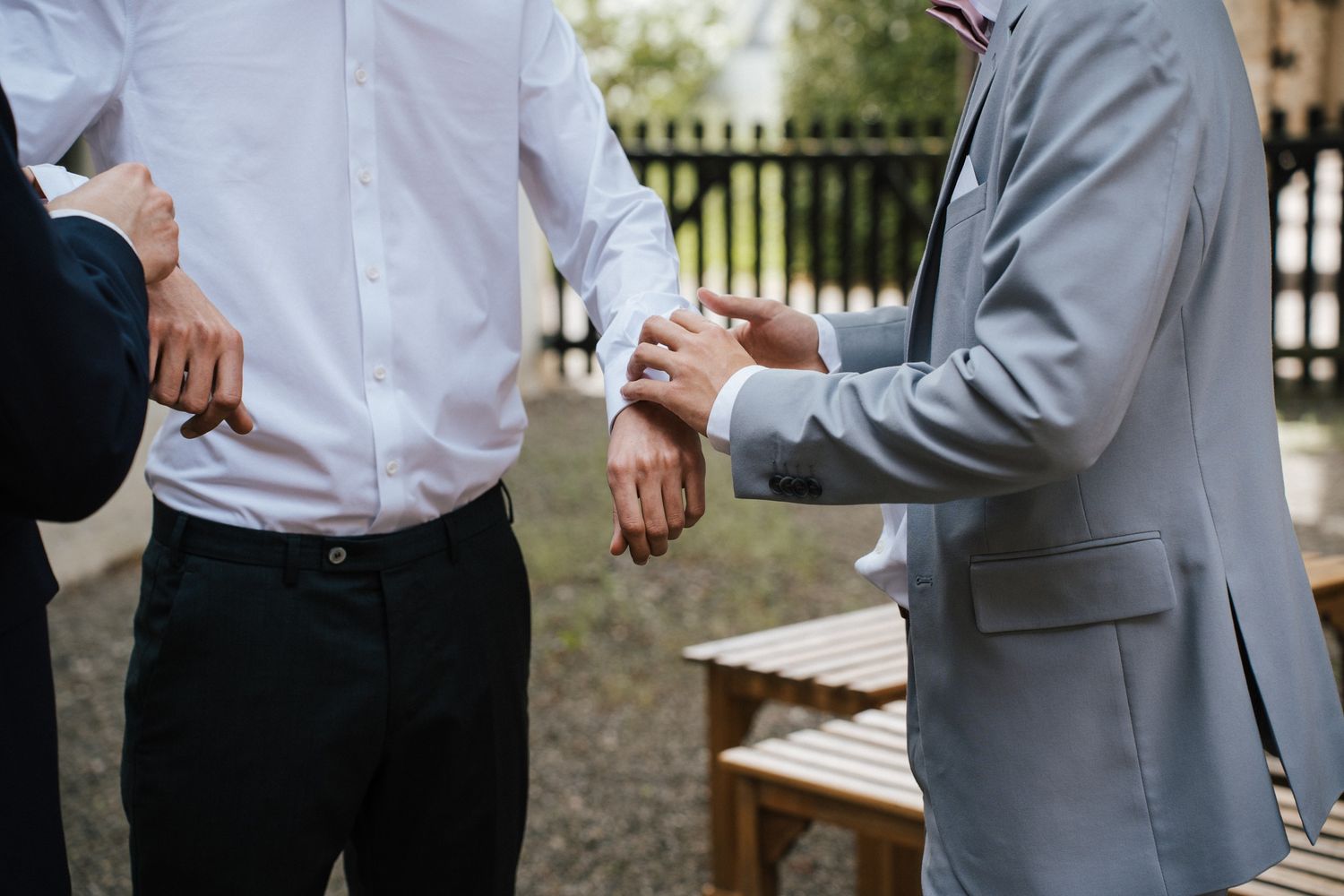
There's nothing to perform. A French cuff takes two hands and a moment of concentration, which is exactly why it photographs well. In the frame above, the cuff is folded back, the cufflink is half through, and burgundy trousers and a warm wooden wall sit softly behind. There's no face in it, and it doesn't need one.
The same goes for shoes, a watch strap, a bow tie that won't sit straight the first time. Hands with a real job to do never look posed.
If someone else is helping, a witness or a brother, let them help for real. The boutonniere is the one worth practising the night before. Pin it from behind the lapel so the pin doesn't show, angle the stem slightly towards the shoulder, and use two pins if the flowers are heavy.
Do grooms really want these photos?
More often than they say beforehand. The usual objection is "nobody needs to see me putting on socks", and that's fair. Nobody does. What people do want to see is the cuff, the shoes, the lapel and the window light, and those come from the same half hour.

A frame like this one is the argument: hands closing the buckle of a brown double-monk shoe, white cuffs, burgundy trousers, worn floorboards. It shows the morning without showing anyone being self-conscious in it.
Common questions
Does the groom need a second photographer?
Not necessarily. If both rooms are close, one photographer can cover both. If they're far apart or the timings overlap, a second shooter is worth considering.
What if the groom gets ready at home?
That works well. Pick the room with the best window, clear one table for the details, and the rest follows.
Should the groomsmen be in the photos?
Only if they want to be. One or two people helping make good pictures. A full room usually doesn't.
When should the boutonniere arrive?
With the bouquet if possible, and into a cool spot straight away. It goes on last.
Do you photograph the bride and groom getting ready on the same day?
Yes. More on how I plan the morning on my page for wedding photography in Zurich.
Before the morning
Pick the room with the window. Clear one table. Lay out the shoes, the cufflinks and the flowers the night before. Leave the shirt unbuttoned until I'm there.
If you're mapping out two getting-ready rooms and aren't sure how the timings fit, tell me where they are on a free discovery call and we'll work out who goes first.