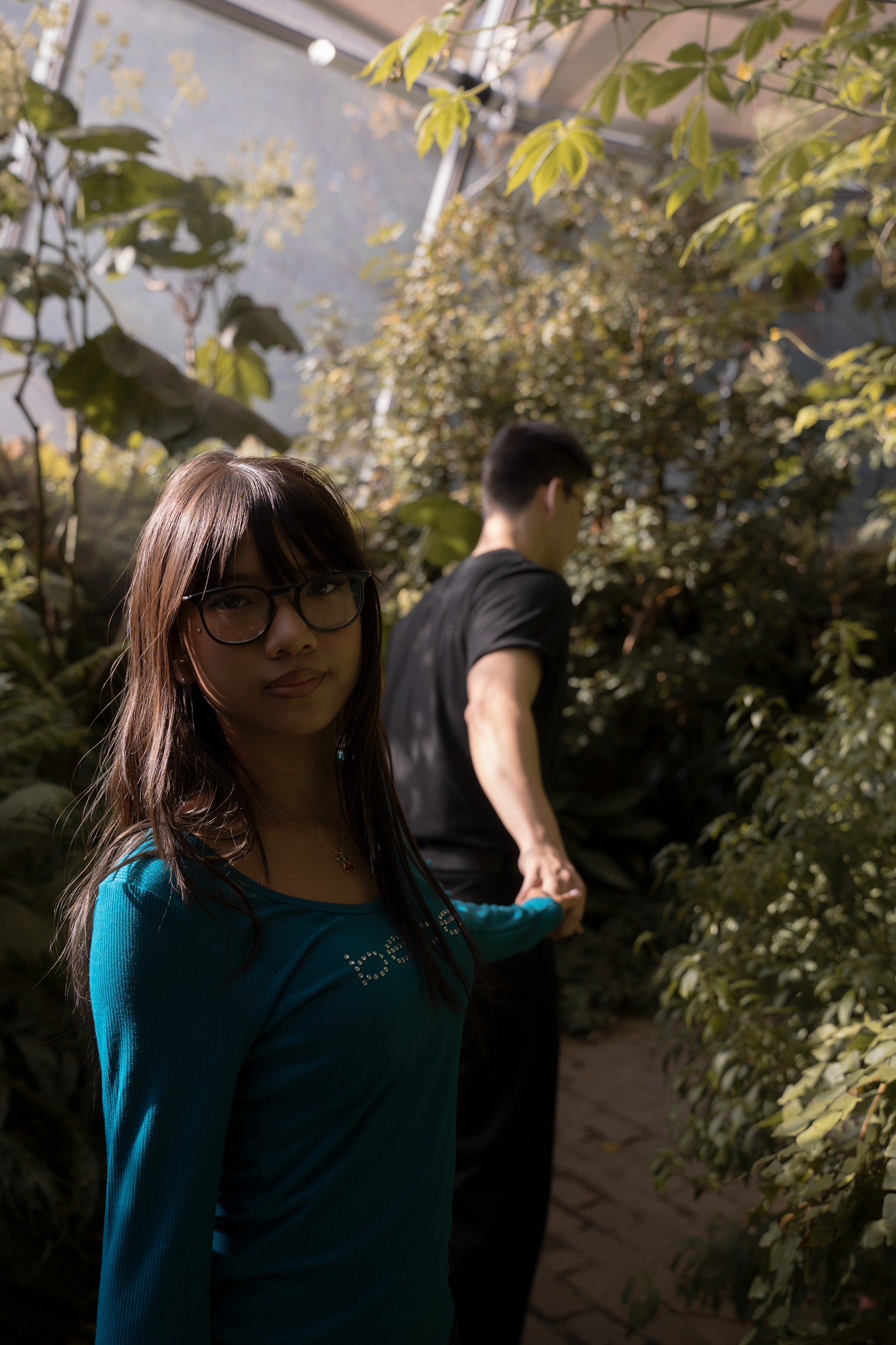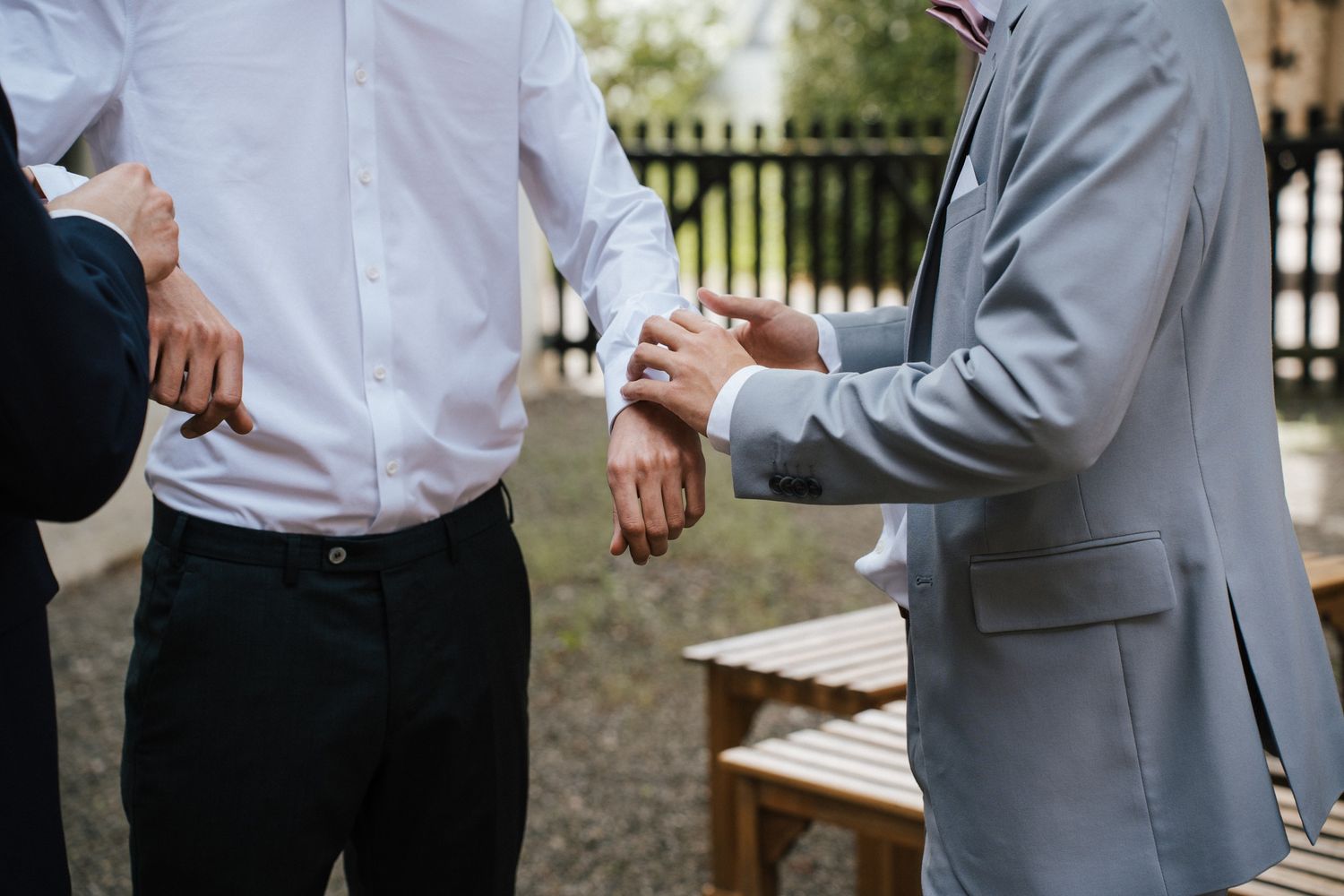

Almost every discovery call gets to the same sentence sooner or later. Somewhere between the date and the venue, one of you says it: "We’re just not good in front of a camera."
I hear it from couples marrying in Zurich’s Old Town and from couples taking a cable car up into the Alps at eight in the morning. It tells me very little. Whether a wedding photo looks natural depends much more on what your hands, your feet and your attention are doing, and all of that can be planned.
The frames in this post come from a summer wedding on Chäserrugg, above the Toggenburg in Switzerland. The tips are the ones I use on almost every wedding day.
Why do people look stiff in photos?
Because standing still while someone looks at you is an odd thing to do.
Most stiff photos have the same three ingredients: two people facing the lens, arms hanging, nothing to do except wait. Change any one of them and the picture changes. Turn towards each other. Give your hands a job. Start moving. You don’t need to feel relaxed to look relaxed in a frame. You just need to be busy with something other than the camera.
That’s also why I don’t arrive with a list of poses. I give small prompts (walk to that rock, sit down here, hold on) and then I step back, often with a longer lens, so there’s real distance between us.
What should you do with your hands in wedding photos?
Hold something. Usually that’s each other.

This frame is only hands: fingers laced together over beaded lace, two rings, a curve of sleeve at the edge. There’s no face in it. It’s still one of the photographs I’d print first from this gallery. Hands that are holding on look like they belong to someone. Hands that hang look like they’re waiting for instructions.
What works:
- Each other’s hands. Laced, or one hand loosely around the other’s fingers.
- A lapel, a waist, the back of a neck. Anywhere you’d put a hand on an ordinary day.
- The bouquet, held low. At the hip, not in front of the chest like a microphone.
- Arm’s length. On the summit they held both hands and leaned back a little, with the dress blowing sideways between them. Two straight arms make a shape the eye follows.
How do you look natural in photos if you feel awkward?
Walk.
It’s the simplest instruction I give and the one that changes the most. Your body already knows how to walk. Your weight shifts, the dress moves, your shoulders come down, and nobody has to think about their chin.

Here it’s a slow walk across the ridge, hand in hand, towards me, with the snow-streaked cliff behind and the skirt swinging forward with each step. In black and white the shapes do most of the work: two figures, one dark line of rock, a lot of pale sky.
A few things that help:
- Walk at about half your normal speed. It will feel ridiculous. It looks right.
- Talk to each other on the way. The subject doesn’t matter.
- Don’t look at me unless I ask.
- Walk the same stretch twice. The second round is almost always looser than the first.
Should you sit down for wedding photos?
Yes, at least once.
Sitting changes the whole shape of a picture. Everything gets lower and closer, the background opens up above you, and a long skirt suddenly has somewhere to go. Late in the evening on Chäserrugg, they sat down in the grass, one behind the other, with the low sun coming from behind and lighting the edges of hair and lace.

If you try it: choose a dry patch, or bring a plain blanket in a neutral colour. Sit closer than seems necessary, because a lens adds distance. Then let the dress fall wherever it falls. A white skirt spread across green grass at sunset is about the most forgiving composition there is.
There’s a practical side too. Twenty minutes standing on a windy ridge is longer than it sounds. Sitting down is a rest that still makes pictures.
Does the weather help or hurt natural wedding photos?
Mostly it helps.
Wind lifts veils and skirts, which puts movement into a frame even when you’re standing still, and a little chaos looks unplanned because it is. There’s a whole post on windy wedding photos if your venue sits high up or near a lake.
Bright midday sun at 2,000 metres is harder. That’s when I look for shade, turn you so the sun is behind you, or switch to black and white, where harsh light turns graphic. Softer light comes at the end of the day, and planning around golden hour explains how to make room for it.
How long do natural wedding portraits take?
About forty-five minutes in total, split into two or three short blocks.
Ten minutes after the ceremony. Twenty somewhere with a view. A short walk around sunset. Short blocks keep the portraits from turning into a photoshoot in the middle of your wedding, and you’re back with your guests before anyone starts looking for you. What time your photographer should arrive shows how those blocks fit into a full day, and the wedding photo shot list covers everything else.
Does an engagement session help?
It’s the best rehearsal there is.
An hour together somewhere around Zurich, months before the wedding, is enough to learn what my prompts sound like, find out that walking slowly is harder than it looks, and laugh about it. On the wedding day, none of it is new.
Common questions
Do we need to practise posing before the wedding?
No. If you’d like to practise anything, practise walking slowly while holding hands. That’s it.
Should we look at the camera?
For a few frames, yes: the family groups and one or two portraits that grandparents will want on a shelf. For everything else, look at each other.
What if one of us is more camera-shy?
Give that person a job. Leading the walk, holding the bouquet, choosing where to sit. Having something to do is the fastest cure I know.
Do you direct at all?
Lightly. I give prompts, not poses, and I’ll fix the obvious things: a twisted veil, a hand hiding the rings, the sun in someone’s eyes.
What if it rains?
An umbrella, a doorway, a big window. Rain gives you a reason to stand close, which solves half of this post on its own.
Do you photograph weddings outside Zurich?
Yes, across Switzerland and the Alps. More about how I work on my page for wedding photography in Zurich.
If one of you just said it
"We’re not good in front of a camera" is where most of my couples start, so it isn’t a problem. Book a free discovery call, tell me which of you said it, and we’ll work out where your walk could be.