A week out, someone checks the forecast, sees gusts of thirty kilometres an hour, and the group chat goes quiet.
I get why. I just don't feel it. Of all the weather a wedding in Switzerland can get, wind is the one I'd choose if anyone asked me: ahead of flat grey cloud, and well ahead of a still, hot afternoon. On a still afternoon people have to perform. Wind does the moving for them.
This post covers how to plan for wind, what to wear, and where I'll ask you to stand.
Is wind bad for wedding photos?
Mostly, no. A breeze gives fabric something to do. Tulle lifts, a chiffon skirt swings out, loose hair crosses the frame. That's movement a still picture otherwise has to fake.
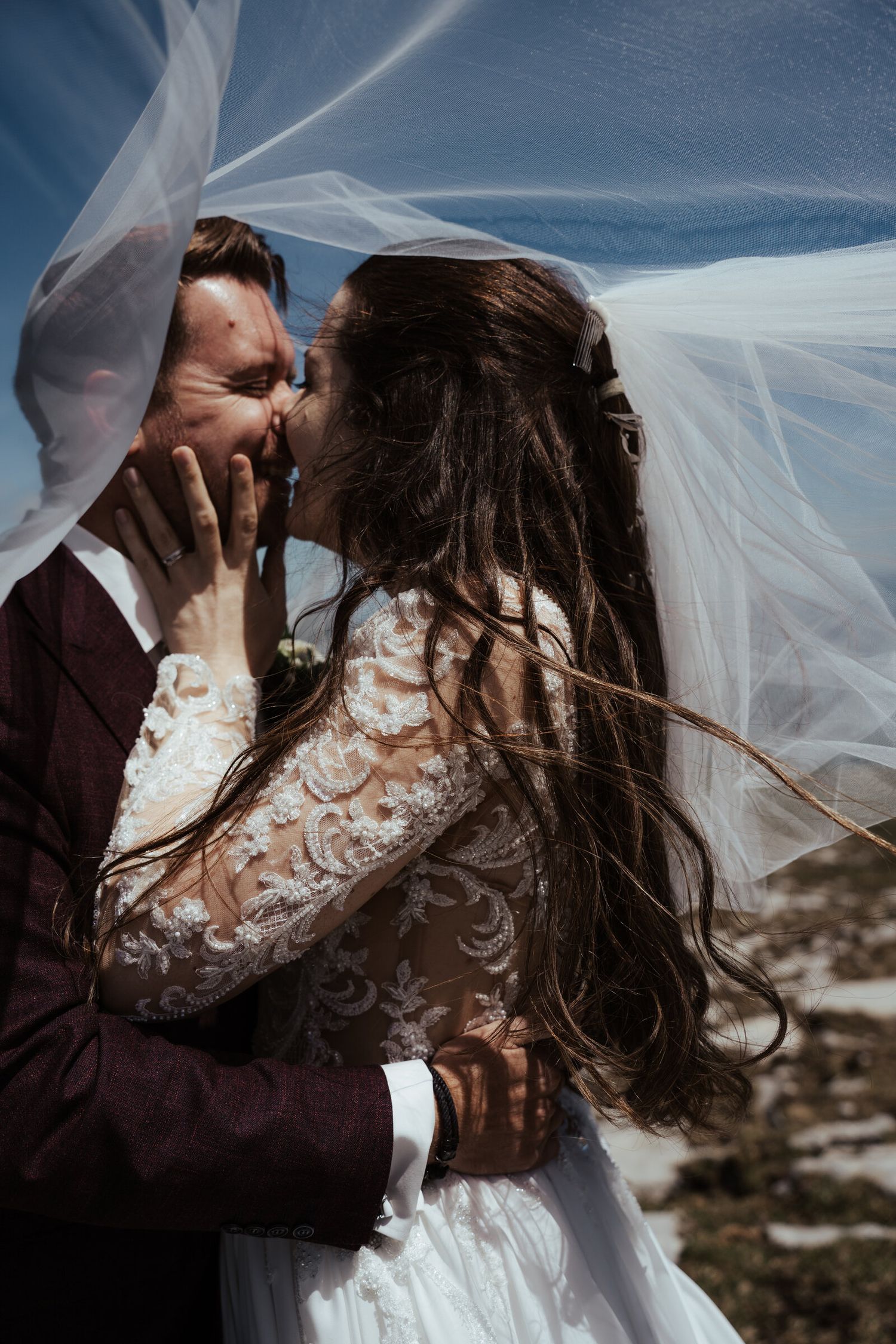
The veil shows it best. On a calm day it hangs straight down your back, and the only way to get it into the air is to have someone throw it, which ends up looking exactly like someone threw it. On the Chäserrugg in the Toggenburg, at 2,262 metres, a whole run of frames in this gallery shows the veil arched over two heads, blue sky coming through the tulle. One of them is the cover of this post.
When wind does cause trouble, it's with sound and comfort, not the pictures. Your officiant's microphone needs a foam windshield, or the vows reach the back row as a rumble. Guests left standing in gusts for twenty minutes stop enjoying the ceremony. That one is a planning problem, not a photography problem: find a sheltered spot for them, and keep the exposed ridge for the two of you.
What should you wear if it's going to be windy?
The fabric matters more than the cut.
Light, loose materials like chiffon, organza, tulle and soft crepe move easily and settle again on their own. Heavy satin and structured mikado hardly react. They stay put, which is fine, but then you give up the one thing wind has to offer. Neither choice is wrong. Just know which one you've made before the final fitting.
Three practical details, none of them romantic, all of them useful:
- Something under the skirt. A light skirt lifts. Slip shorts cost next to nothing and take the worry out of every gust.
- Shoes with a strap. Ankle-strap flats or low block heels grip grass and gravel. A thin stiletto sinks into an Alpine meadow on the first step.
- A layer between photos. A wrap or jacket over your shoulders while we walk. It comes off for a few minutes at a time, not for the whole session.
How do you keep your veil and hair from blowing everywhere?
You can't, not completely, and the pictures get better once you stop trying.
The longer answer: pin the veil comb with two bobby pins crossed over its teeth, so it holds when the tulle catches a gust. A cathedral-length veil travels furthest and makes the biggest shapes. A fingertip veil flicks rather than floats. Both work; just decide which picture you're after.
With hair, half-up styles cope best. The top stays in place and the lengths move. Fully loose hair will cross your face at some point, so keep one clip in a pocket, or give it to someone nearby, for the moments you want it back.
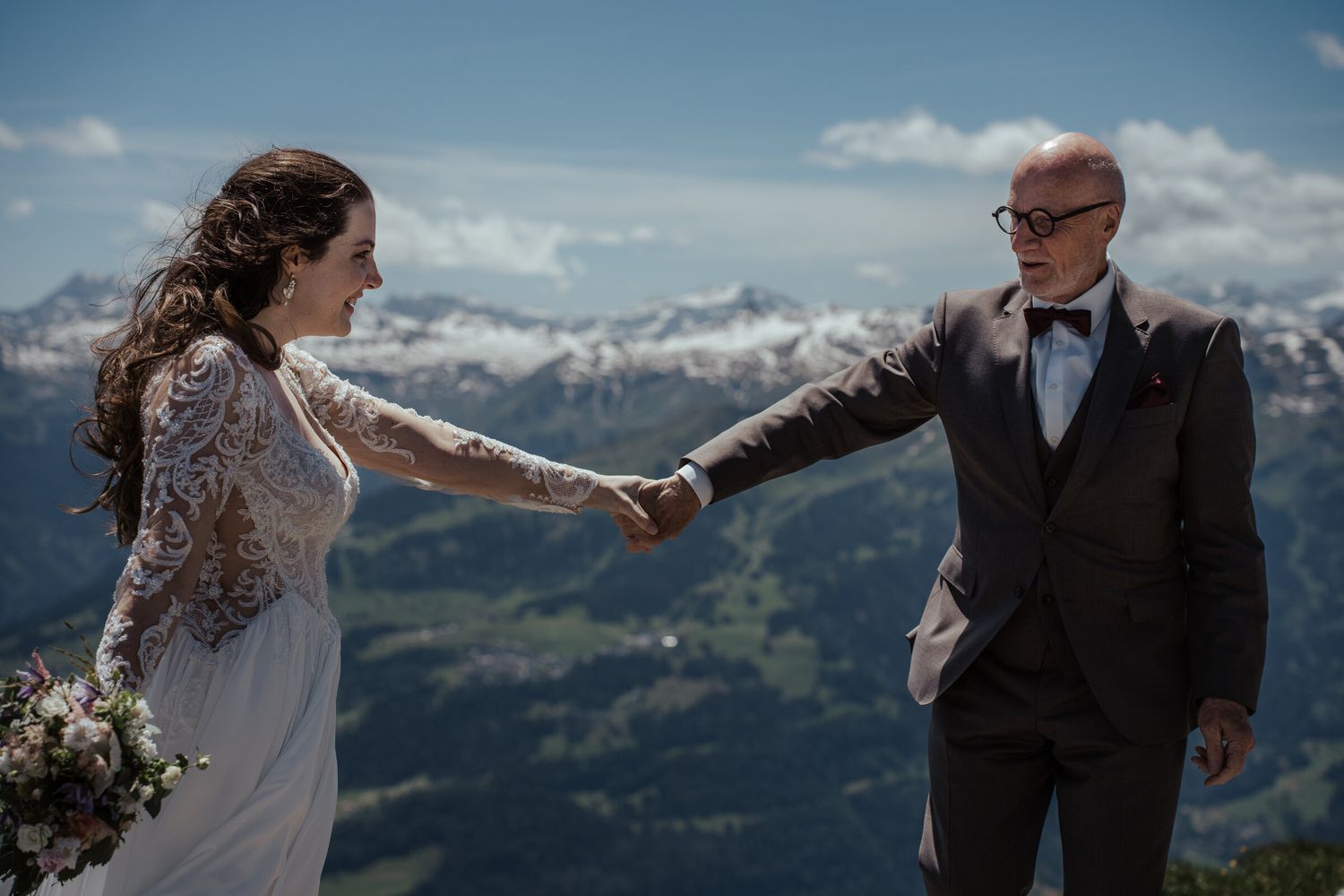
Then the trick that does most of the work: turn your face into the wind. Hair and veil stream out behind you instead of across your mouth. The frame below shows it plainly: two hands joined at arm's length, hair blown straight back off the face, snow on the range behind. I'll stand so the wind crosses the frame from the side. That pulls the veil out sideways rather than straight at the lens.
When is it least windy in the Swiss mountains?
Often early and late, rarely in the middle of the afternoon. On sunny days in the Alps, warming air tends to push wind up the valleys through the afternoon, and it often eases as the sun drops. That's a tendency, not a promise. A summit ridge is rarely completely still.
Two Swiss winds are worth knowing by name. The Föhn is a warm, dry wind that comes down the northern Alpine valleys, and it clears the air so thoroughly that distant peaks you'd usually see as haze come in sharp. The Bise is a cold northeasterly across the Swiss plateau and Lake Zurich: steady, chilly, and known for making a bright day feel a lot colder than it looks. Neither one ruins a wedding. The Bise just means bringing a coat.
If the forecast shows real gusts, the kind that knock people off balance, I'll move us to the sheltered side of a building or a line of trees. Portraits don't need a calm day. They need somewhere out of the worst of it to stand.
Can you still get romantic portraits on a windy evening?
Yes, and the wind often gives them their shape.
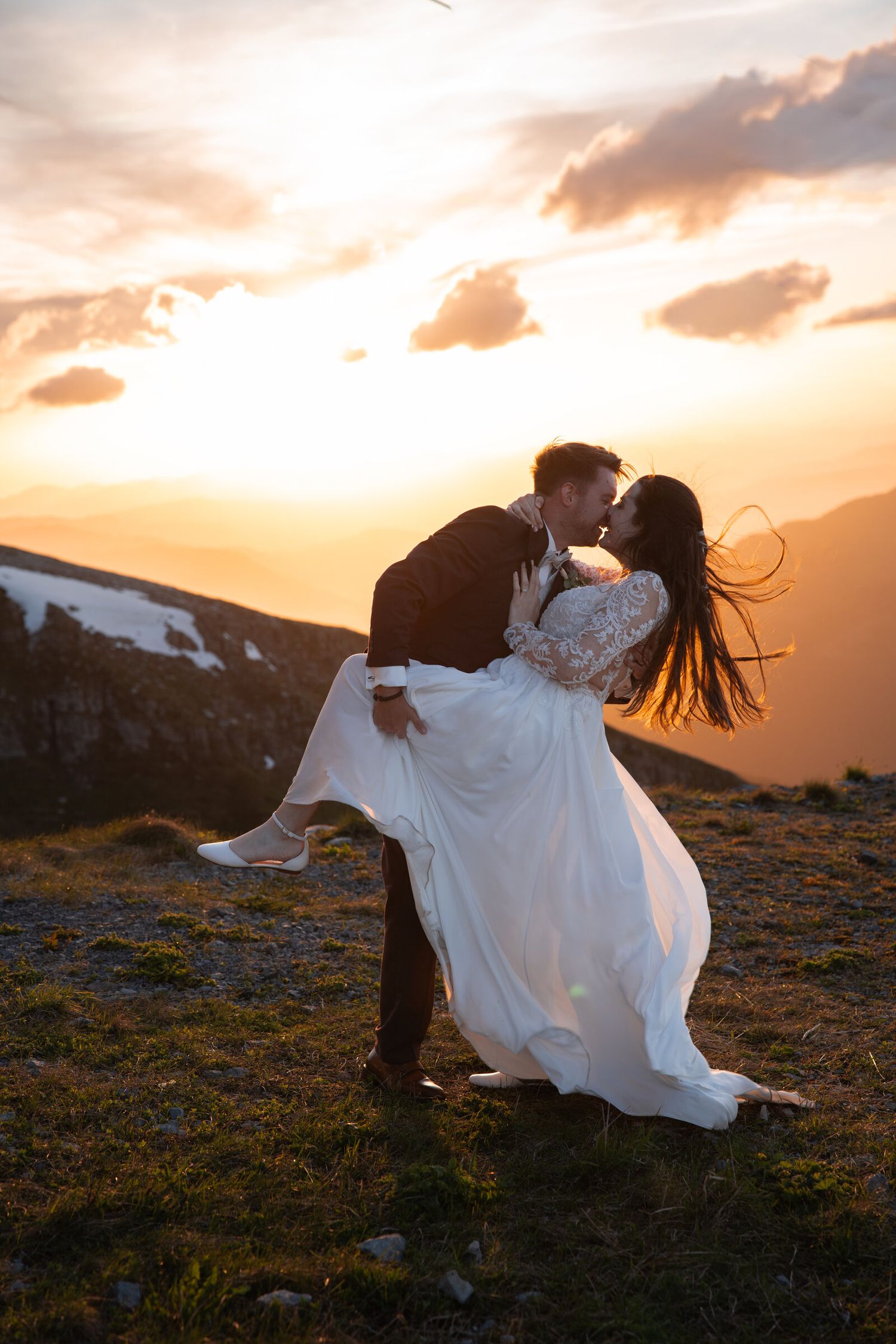
This one is from sunset on the same ridge. The hair is pulled out almost flat to one side, the skirt is lifted clear of the ground, and one white ankle-strap shoe is in the air. The sun is behind a bank of cloud and turns the whole sky orange. No stylist could arrange hair like that. If you want to know when that light reaches your own venue, I've written up golden hour timing for Swiss weddings.
That's what I value most about wind: it keeps people moving. It's hard to hold a stiff pose while your veil is trying to leave, so the frames loosen up quickly. That suits how I work anyway. I'd rather stand back and notice than direct.
What if the wind drops completely?
Then the pictures change. They don't get worse.
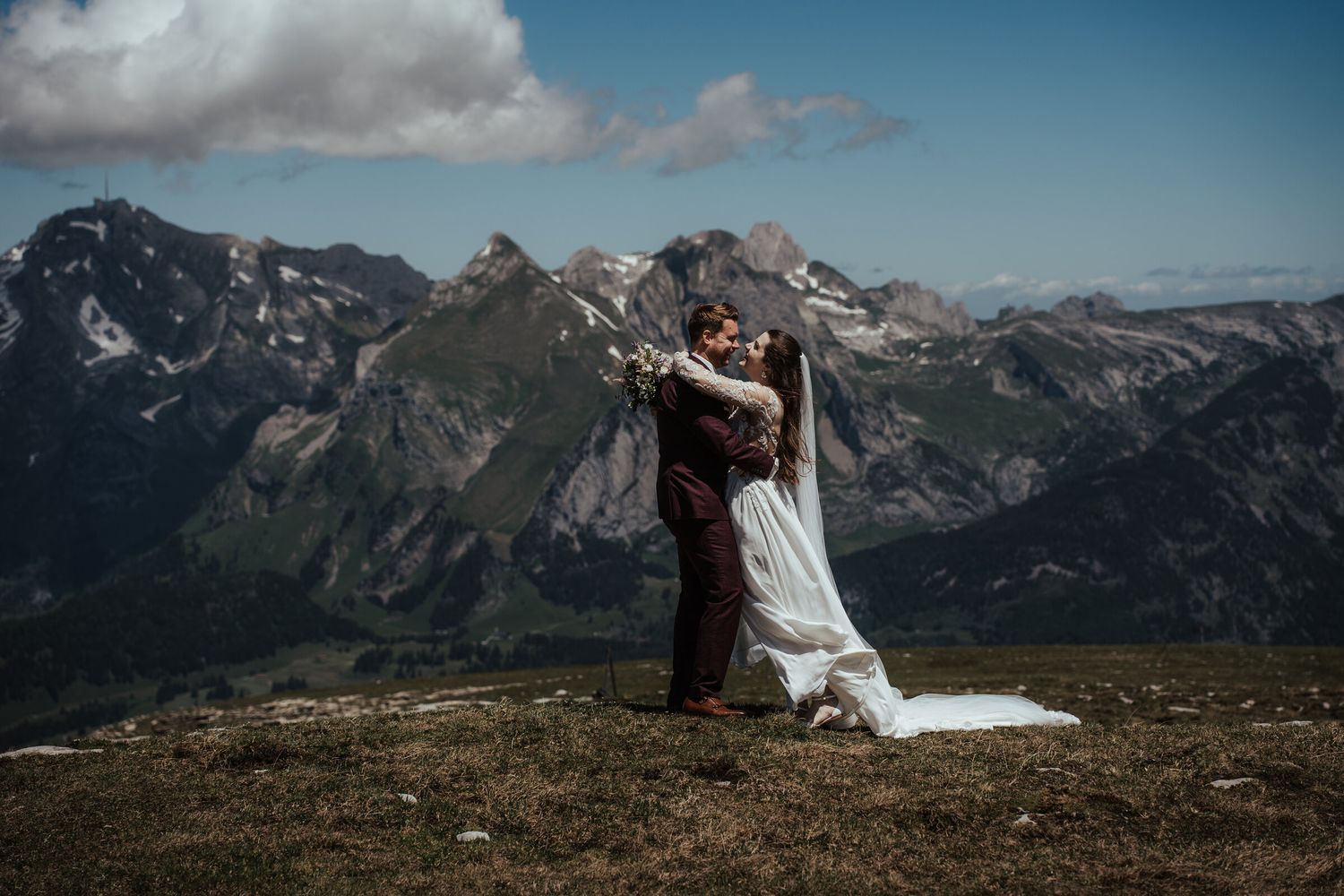
Calm air gives you what wind can't: a train laid flat across the grass, a veil hanging straight down, clean lines against a big view. In the frame below the dress is spread out along the ground behind two figures on the ridge, with a line of jagged peaks behind them and one large cloud over the left of the sky.
A good plan for a windy day covers both. Use the gusts while they last, and don't chase them once they've gone.
Common questions
Should we move the ceremony indoors if it's windy?
Only if it becomes unsafe or nobody can hear. A breeze isn't a reason to move. Get a windshield for the microphone and seat guests out of the worst of it.
Will my makeup survive the wind?
Wind dries skin and blows hair across fresh lipstick. A long-wear lip colour and a small touch-up kit with someone close by cover most of it.
Do veils work outdoors in the mountains?
Very well, as long as the comb is pinned firmly. The lighter and longer the veil, the more it moves.
Is it too cold for photos at altitude?
Usually colder than the valley forecast says. Keep a layer on between frames and take it off only for the few minutes we need.
What is the Föhn, and should we worry about it?
A warm, dry wind in the northern Alps that often brings unusually clear views. Worth pinning your veil properly for. Not worth worrying about.
Do you photograph in bad weather?
Yes: rain, cloud, wind, all of it. More on how I work on my page for wedding photography in Zurich.
Before the day
Check the forecast for wind, not just rain. Pin the veil properly. If you want movement, choose a skirt that moves. Leave the rest to the weather.
Planning something exposed, like a summit, a lakeshore, or a vineyard terrace above Lake Geneva? Tell me where on a free discovery call, and I'll tell you which side of the building I'd stand on.